
Results
-
 £39.95
Judd: Lord of the Sea
Each movement of this suite is linked with a quotation from the Bible; 1. Water's edge ('And Jesus went forth...by the sea-side...' Mark 2 v.13). 2. Seascapes ('His dominion shall be from sea to sea' Zechariah 9 v.10). 3. Seafarer's song ('Sing unto the Lord...ye that go down to the sea' Isaiah 42 v.10). The first two movements are based on the composer's own settings of poems by Miriam Richards. The third movement (generally lively in characater) introduces a broad hymn-like melody not associated with any words in particular but nevertheless evoking a spirit of exaltation and praise.
Estimated dispatch 7-14 working days
-
 £59.95
Judd: My Strength My Tower - Contest Version
This music consists of a theme followed by five extensive variations. The theme is the composer's own tune set to the words, 'Thee will I love, my strength, my tower', a hymn by Johann Scheffler translated by John Wesley. A strong modal flavour is characteristic of the theme. Variation 1 This is a light and graceful variation with a good deal of imitative writing. It leads, without a break, into the next variation. Variation 2 Fire and ferocity are asked for in the course of this variation. Variation 3 This variation demonstrates the original approach of the composer. Solo lines for cornet and euphonium are included with their arabesques and arpeggii. Variation 4 Taking the form of a passacaglia, the 'ground' is given out at once by the basses. Fragments of the 'ground', plain or decorated, are combined and used in a number of ways, revealing the composer's mastery of counterpoint. Variation 5 The briskly moving and scintillating final variation abounds in sudden variations of dynamic. The tempo remains constant until an increase is called for in the coda. This 'contest' version has been prepared by Brian Bowen who was asked to re-work the percussion part and introduce a repiano cornet part (Salvation Army band publications do not, in general, have a part for repiano cornet).
Estimated dispatch 7-14 working days
-
 £39.95
Judd: The Great Salvation War
James Curnow was inspired to compose this work after reading 'Marching to Glory', a history of The Salvation Army in the USA. The writer of the book, Dr. Edward H. McKinley, was a colleague of Curnow on the faculty of Asbury College and a member of The Salvation Army Student Fellowship Band. The work was written for this band and premiered by them at the Centennial National Congress in 1980 which was held at Asbury College. Curnow has endeavoured to capture the spirit of early day Salvationists as they gave themselves completely to the great salvation war. Three songs support the three-part structure; 1) Stand like the brave 2) In Thee, O Lord, do I put my trust 3) Rescue the perishing.
Estimated dispatch 7-14 working days
-
 £29.95
Judd: The Light of the World
Undoubtedly an SA 'classic', this Dean Goffin piece attempts to create in music Holman Hunt's famous picture of Christ standing outside the heart's door. Featuring the well known hymn tune 'Aurelia', this is another SA composition to achieve the 'accolade' of being featured on the Essays for Brass series (Vol. 1).
Estimated dispatch 7-14 working days
-
 £29.95
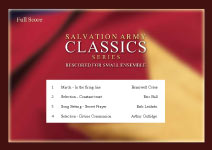
Salvation Army Classics 1-4 for Small Ensemble
Salvation Army Classics arranged for Smaller Ensembles Series 1 - 4March - In the Firing LineSelection - Constant TrustSong Setting - Secret PrayerSelection - Divine Communion This series features pieces that have been rescored for Unity Series (five-part) scoring.PART I 1st Cornet BbPART II 2nd Cornet Bb and 1st Horn EbPART III 2nd Horn Eb and Baritone or Trombone BbPART IV Euphonium BbPART V Bass Eb and Bass BbThese transcriptions have been carried out in such a way to facilitate the addition of any original parts that may be available.Where relevant, suggestions are made for a variation in tone colour (i.e. 2nd Cornet, Flugel, Baritone, Trombone) as well asthe occasional opportunity for rest.
Estimated dispatch 7-14 working days
-
 £45.00
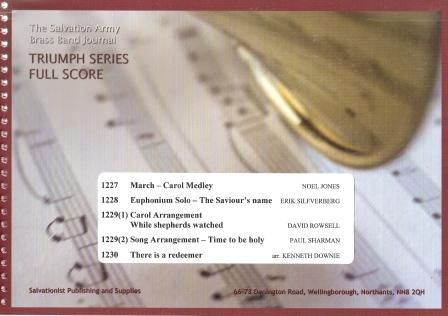
Triumph Series Band Journal July 2012 Numbers 1227 - 1230
No. 1227 March - Carol Medley (Noel Jones)This march features three carols, 'God rest ye merry, gentlemen', Hark! The herald angels sing' and 'Deck the Hall' together with brief references to others in a medley form. A couple of these references are somewhat camoflaged which provides further interest.No. 1228 Euphonium Solo - The Saviour's Name (Erik Silfverberg)A setting of Jane Clarke's lovely melody set to familiar words, 'There is a name I love to hear'.No. 1229 (1) Carol Arrangement - While shepherds watched (David Rowsell)A four-verse setting of the 16th Century tune, 'Winchester Old' commonly associated with the carol, 'While shepherds watched their flocks by night'.No. 1229 (2) Song Arrangement - Time to be holy (Paul Sharman)This arrangement of George Cole Stebbins' tune was originally made for the 2010 World Youth Convention in Sweden, the theme of which was 'Time to be holy'.No. 1230 There is a redeemer (Kenneth Downie)Melody Green-Sievright's popular song, 'There is a redeemer' was first published in 1982, 30 years before the appearance of this new setting.
Estimated dispatch 7-14 working days
-
 £20.00
Infinity (Brass Band - Study Score)
In the post-modern age in which we live, 'absolutes' are difficult for many to comprehend. Yet infinity, which means absolute, total, all-embracing, having no limits or boundaries in time, space, extent, or magnitude, has always been central to the Christian's concept of God.Through the ages, as human understanding has grown, particularly at a remarkable rate from the latter part of the twentienth century, Christianity has been continually challenged to interpret traditional beliefs in the light of new discoveries, but always within the reality of the infinite Being. In addition, scripture tells us that 'humanity was made in God's image'. Humankind is part of God's creation and as such, responsible for its upkeep. Such a commission has never been more relevant than in this present age. Psalm 8 creates a great picture of the majesty, eternal, infinte quality of God and yet reveals the desire of God to share in spirit with humankind. It recognises humankind as being, not a tool of the infinite, but as a creative contributing part of the ongoing movement and activity of the infinite. The music is deliberately melodic in context, creating a sense of unity with the infinite, in tandem with the varying expressions of individuality. It is not based on the Psalm but reflects some of the sentiments lying therein. The 'hymn-like' theme expresses the nature of the Divine using the Old Testament image of the infinite God coming to finite humankind, not in the 'wind', the 'earthquake', the 'fire', but in the 'still small voice' of quietness (1 Kings 19: 11-13). The ensuing musical development, in different styles and patterns, expresses this continual link between infinite and finite. Thus the conclusion, rather than being a symbol of might, power and magnificence, reflects the same sentiment as the opening.
Estimated dispatch 7-14 working days
-
 £119.95
Harrison's Dream (Brass Band - Score and Parts)
At 8.00pm on the 22nd of October 1707, the Association, flagship of the Royal Navy, struck rocks off the Scilly Isles with the loss of the entire crew. Throughout the rest of the evening the remaining three ships in the fleet suffered the same fate. Only 26 of the original 1,647 crew members survived. This disaster was a direct result of an inability to calculate longitude, the most pressing scientific problem of the time. It pushed the longitude question to the forefront of the national consciousness and precipitated the Longitude Act. Parliament funded a prize of �20,000 to anyone whose method or device would solve the dilemma. For carpenter and self-taught clockmaker John Harrison, this was the beginning of a 40 year obsession. To calculate longitude it is necessary to know the time aboard ship and at the home port or place of known longitude, at precisely the same moment. Harrison's dream was to build a clock so accurate that this calculation could be made, an audacious feat of engineering. This work reflects on aspects of this epic tale, brilliantly brought to life in Dava Sobel's book Longitude. Much of the music is mechanistic in tone and is constructed along precise mathematical and metrical lines. The heart of the work however is human - the attraction of the �20,000 prize is often cited as Harrison's motivation. However, the realisation that countless lives depended on a solution was one which haunted Harrison. The emotional core of the music reflects on this, and in particular the evening of 22ndOctober 1707. Peter GrahamCheshireJuly 2000
Estimated dispatch 7-14 working days
-
£37.95
Harrison's Dream (Brass Band - Score only)
At 8.00pm on the 22nd of October 1707, the Association, flagship of the Royal Navy, struck rocks off the Scilly Isles with the loss of the entire crew. Throughout the rest of the evening the remaining three ships in the fleet suffered the same fate. Only 26 of the original 1,647 crew members survived. This disaster was a direct result of an inability to calculate longitude, the most pressing scientific problem of the time. It pushed the longitude question to the forefront of the national consciousness and precipitated the Longitude Act. Parliament funded a prize of �20,000 to anyone whose method or device would solve the dilemma. For carpenter and self-taught clockmaker John Harrison, this was the beginning of a 40 year obsession. To calculate longitude it is necessary to know the time aboard ship and at the home port or place of known longitude, at precisely the same moment. Harrison's dream was to build a clock so accurate that this calculation could be made, an audacious feat of engineering. This work reflects on aspects of this epic tale, brilliantly brought to life in Dava Sobel's book Longitude. Much of the music is mechanistic in tone and is constructed along precise mathematical and metrical lines. The heart of the work however is human - the attraction of the �20,000 prize is often cited as Harrison's motivation. However, the realisation that countless lives depended on a solution was one which haunted Harrison. The emotional core of the music reflects on this, and in particular the evening of 22ndOctober 1707. Peter GrahamCheshireJuly 2000
Estimated dispatch 7-14 working days
-
 £99.95
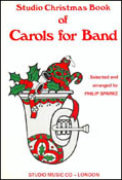
Carols for Band (Brass Band - Score and Parts)
Designed to be playable by any combination from quartet to full brass band, wind band or orchestra, the arrangements in this book with provide a practical solution to all your carolling needs. Parts are divided into Soprano, Alto, Tenor and Bass so that any suitable instrumentation will sound well, providing an equal balance of players per voice is maintained. The carols are printed in alphabetical order so they are easy to find, and comprehensively indexed under both first line and name of tune.Score, Timpani and Percussion parts are available separately.Instrumentation is as follows: Brass BandWind BandStringsSopranoEb Soprano CornetSolo Bb CornetBb Repiano & Flugel1st Flute & Piccolo2nd FluteOboe1st Bb Clarinet1st Bb Trumpet/Cornet1st ViolinAlto2nd & 3rd Bb CornetSolo Eb Horn1st Bb Trombone2nd & 3rd Bb ClarinetsEb Alto Saxophone2nd Bb Trumpet/Cornet1st F Horn2nd ViolinTenor1st & 2nd Eb Horns1st & 2nd Bb Baritones2nd Bb Trombone1st Bb EuphoniumEb Alto ClarinetBb Tenor Saxophone2nd F Horn1st & 2nd TrombonesViolaBassBass Trombone2nd Bb EuphoniumEb BassBb BassBassoonBb Bass ClarinetEb Baritone SaxophoneBass TromboneEuphoniumTubaCello/BassTitles included:Angels from the Realms of GloryAs with Gladness Men of OldAway in a MangerBrightest and BestChristians AwakeCoventry CarolDeck the HallsDing Dong, Merrily on HighFirst NowellGod Rest ye Merry, GentlemenGood King WenceslasHark the Glad SoundHark, the Herald Angels SingHolly and the IvyI Saw Three ShipsIn Dulci JubiloIn the Bleak Mid-WinterInfant HolyInfant KingIt Came Upon a Midnight ClearJingle BellsLo, He Comes with Clouds DescendingLove Came Down at ChristmasO Come, All ye FaithfulO Come, O Come, EmmanuelO Little Town of BethlehemOf the Father's Love BegottenOnce in Royal David's CitySans Day CarolSee Amid the Winter's SnowSilent NightSussex CarolThou Didst Leave Thy ThroneUnto Us is Born a SonWe Wish You a Merry ChristmasWhile Shepherds WatchedThe Brass Band Set consists of 25 Parts:1 x Eb Soprano Cornet4 x Solo Bb Cornet2 x Bb Repiano & Flugel4 x 2nd & 3rd Bb Cornet1 x Solo Eb Horn2 x 1st & 2nd Eb Horn2 x 1st & 2nd Bb Baritone1 x 1st Bb Trombone1 x 2nd Bb Trombone1 x Bass Trombone1 x 1st Bb Euphonium1 x 2nd Bb Euphonium2 x Eb Bass2 x Bb Bass
Estimated dispatch 7-14 working days